A Personal Philosophy on Work, Life, and Design
I did not set out to develop a philosophy. I backed into one. It came from watching the same problems repeat across teams and organizations while the people inside them kept paying the price.
I didn't set out to build a philosophy. I ended up with one because I kept running into the same problems over and over again, in different places, with different people, and under different labels.
Teams would work incredibly hard. Leaders would stay late. Everyone would care. And still, outcomes were inconsistent. Things worked when the right person stepped in at the right moment, and they fell apart when that person wasn't there. When success happened, we called it hustle. When it didn't, we talked about execution. What we almost never talked about was the system those people were working inside.
For a long time, I accepted that as normal. Eventually, I couldn't.
At some point it becomes obvious that relying on effort to carry important outcomes isn't just inefficient. It's unfair. It quietly transfers risk onto people and then praises them for absorbing it. That realization sits underneath almost everything I believe about leadership, work, and how life actually plays out.
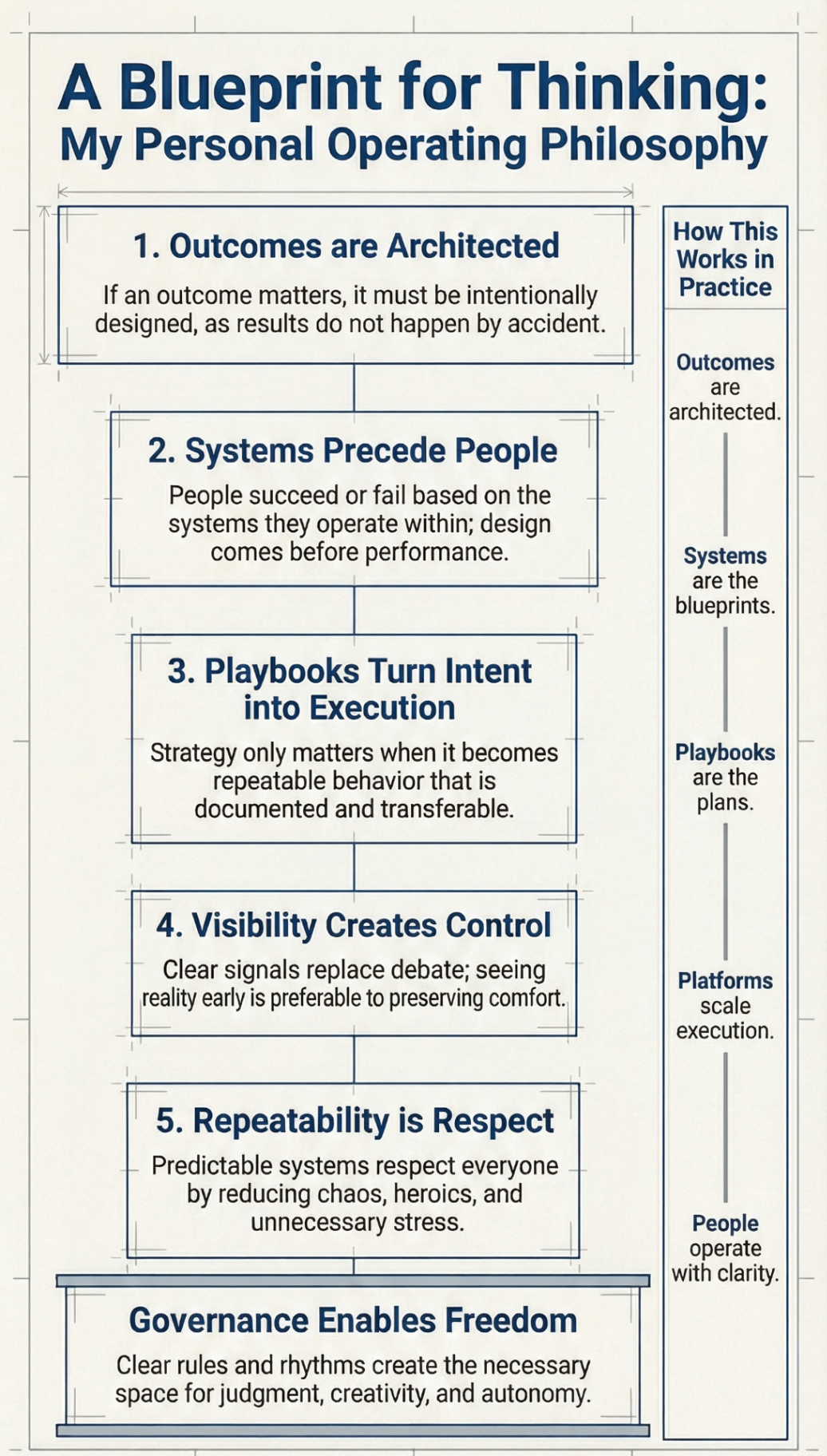
Outcomes Are Designed, Not Discovered
I don't believe meaningful outcomes are discovered. I think they're designed. If something matters, a business result, a client experience, a commitment you've made to yourself, it deserves more than hope and good intentions. Working harder isn't a system. And depending on exceptional people to save broken processes only works until it doesn't.
When something breaks, my instinct isn't to look for who messed up. It's to look at what in the design made that failure possible. I'd rather find the thing that actually leads to change than find someone to blame for it. If the only way a system works is when people go above and beyond, then the system is already asking too much.
Systems Shape Behavior More Than Motivation
Over time, I've come to believe that systems shape behavior far more than motivation ever will. Good people don't usually fail because they stop caring. They fail because they're operating inside structures that are vague, inconsistent, or quietly contradictory. Expectations shift. Priorities collide. Rules change depending on context. People compensate for a while by working longer, staying later, and carrying more stress than they should. Eventually, that bill comes due.
That's why I tend to focus on systems before people. Clear ownership. Clear flows of work. Clear definitions of what "good" actually looks like. Not to box anyone in, but to give them something solid to operate within. A broken system will eventually wear down even strong performers. Fixing the person without fixing the system just postpones the outcome.
Intent Must Become Behavior
I've also learned that intent means very little unless it turns into behavior. Most teams don't lack vision. They lack translation. The real operating system isn't what gets said in meetings. It's what happens by default, when no one is watching, when people are tired, or when pressure hits.
That's where playbooks come in, not as bureaucracy, but as memory. If something is important, it should be teachable. If it can't be taught, it can't scale. And if it can't scale, it will eventually depend on heroics. I'd rather invest time making good decisions repeatable than spend my days answering the same questions in slightly different forms.
Visibility Creates Clarity
I also care a lot about visibility, probably more than is comfortable at times. I'd rather see reality early than preserve a story that collapses later. Visibility isn't about control or surveillance. It's about shared understanding. When reality is visible, conversations get simpler. Decisions get cleaner. When it isn't, people argue about narratives instead of fixing what's actually broken.
If something matters, it should be visible without a long explanation. If it requires constant narration, the signal is wrong.
Alignment Over Speed
One pattern I've become especially sensitive to is local optimization. Teams move fast, solve their own problems, and unintentionally create friction everywhere else. Over time, tools multiply, definitions drift, and trust erodes. Everyone is busy. Very little gets better. I'm willing to slow things down to get alignment right because fragmented excellence is still failure. Alignment is what allows scale without chaos.
That same logic applies outside of work, whether we admit it or not. Optimizing one area of life while quietly degrading the rest isn't progress. It's deferred cost.
Stability Is a Form of Respect
I've also come to see stability as a form of respect. Chaos has a human tax. When work is unpredictable, people can't plan their lives. When everything feels urgent, nothing is sustainable. When heroics are praised, exhaustion becomes inevitable. A system that works when people are tired or distracted is better than one that only works when everyone is exceptional, and that reliability is worth more than the occasional burst of brilliance a chaotic system might produce.
Structure Enables Freedom
Structure plays a big role here. I don't see it as restrictive. I see it as enabling. Clear rules, roles, and rhythms reduce noise. They remove the need for constant escalation and second guessing. They give people room to use judgment without having to guess where the boundaries are. Freedom without structure turns into chaos. Structure without freedom turns into control. The balance lives in making expectations explicit.
This Isn't About Work-Life Balance
At some point, I realized this way of thinking didn't stop at work. The same design failures that burn people out professionally show up in personal life too. The idea of work-life balance assumes work and life are separate systems competing for time and energy. They aren't. There's one body. One mind. One finite life. Work is one of the strongest forces running through that life, not something separate from it.
When work undermines health, relationships, or integrity, that's usually a sign the system was built wrong, not a sign you failed to balance it correctly.
The real question isn't how to balance work and life. It's whether the system you're building can hold under pressure without breaking you or the people around you.
Responsibility Follows Intent
I didn't choose how I entered the system. None of us did. But once intent exists, responsibility follows. Whether I'm working on a team, a business, or my own life, the goal is the same. I want systems where the right outcomes happen by default, not by sacrifice.
I'm not interested in working harder inside broken systems. I'm interested in designing systems that work, so people don't have to break themselves to make them succeed.
That's as close as I can get to my philosophy.