Why Federated Operations Are Becoming A Go To Model For Scaling Complexity
Today, many organizations operate across different markets, service types, regulatory environments, and delivery cadences at the same time. In that reality, centralization alone does not create clarity. This is where federated operating models have started to show up as a practical answer.
For a long time, centralization was the gold standard of operational maturity. As organizations grew, they added layers of coordination, approval, and oversight to create stability. That approach made sense when scale was limited, offerings were narrow, and variation could be managed through uniform process.
That world does not really exist anymore for most growing firms.
Today, many organizations operate across different markets, service types, regulatory environments, and delivery cadences at the same time. They sell in different ways, deliver in different ways, and earn margin through very different economic engines. In that reality, centralization alone does not create clarity. It often creates distance.
This is where federated operating models have started to show up as a practical answer.
In a federated model, execution authority and accountability sit with semi autonomous units that are close to the work, while governance, standards, financial controls, and systems of record remain centralized. It is not loose decentralization. It is structured autonomy inside a shared operating framework.
You can see this pattern in a lot of recent guidance around digital, data, and AI. For example, a McKinsey analysis of digital service operating models notes that many organizations begin with a centralized setup but then shift to a federated model when they try to scale that capability across the enterprise.
In data governance, industry write ups point out that federated models have grown more popular in recent years, especially in the context of data mesh style architectures where domain teams own their data products inside a shared governance framework.
And in gen AI, guidance for data and AI leaders often recommends a federated approach where business domains take responsibility for both using and shaping AI in their area, while a central function sets standards and provides common platforms.
The appeal is not theoretical. It is about matching ownership to reality.
In a fully centralized organization, accountability tends to drift upward. Delivery problems become escalations rather than ownership issues. Margin erosion becomes a finance conversation after the fact rather than a real time operating concern. Decisions slow down because authority sits far from context.
A federated model reverses that drift. It places delivery, staffing, utilization, scope, and client outcomes into the hands of leaders who live inside those realities every day. Economic responsibility moves closer to execution. Risk becomes visible earlier. Tradeoffs become explicit instead of abstract.
At the same time, federation does not mean walking away from standards. In well designed federated systems, financial policy, delivery methodology, legal controls, escalation rules, and enterprise platforms remain centrally owned. Local leaders are free to operate, but not free to redefine the rules of the game. Autonomy lives inside guardrails.
That balance addresses one of the hardest scaling problems any organization faces: how to move fast without fragmenting.
Different business lines almost always need different rhythms. One business might operate on short cycle, high volume engagements. Another might run long, complex programs. One might be deeply regulated, another more experimental. Trying to cram all of that into a single centralized execution pattern usually forces a bad choice. Either speed gets sacrificed in the name of control, or control gets sacrificed in the name of speed. Federation removes a lot of that tension.
There is another benefit that does not get talked about as much: economic clarity.
When responsibility is highly centralized, it becomes surprisingly hard to see where value is created, where it is consumed, and where it leaks out. Costs blur across shared resources. Performance becomes a narrative game. In a federated model, operating units carry visible responsibility for their own outcomes inside a shared financial framework. Complexity does not go away, but it becomes easier to read.
Federation also lines up well with how work actually flows.
In most organizations, work does not move as one smooth stream. It passes through distinct stages: revenue creation, delivery execution, renewal, expansion, and financial realization. In centralized structures, these stages are often handled by loosely connected teams whose authority overlaps in fuzzy ways. In a federated structure, lifecycle ownership becomes explicit. Different executive functions own different stages, while federated units execute within those stages. Handoff points are clearer, and fewer problems fall into the gaps.
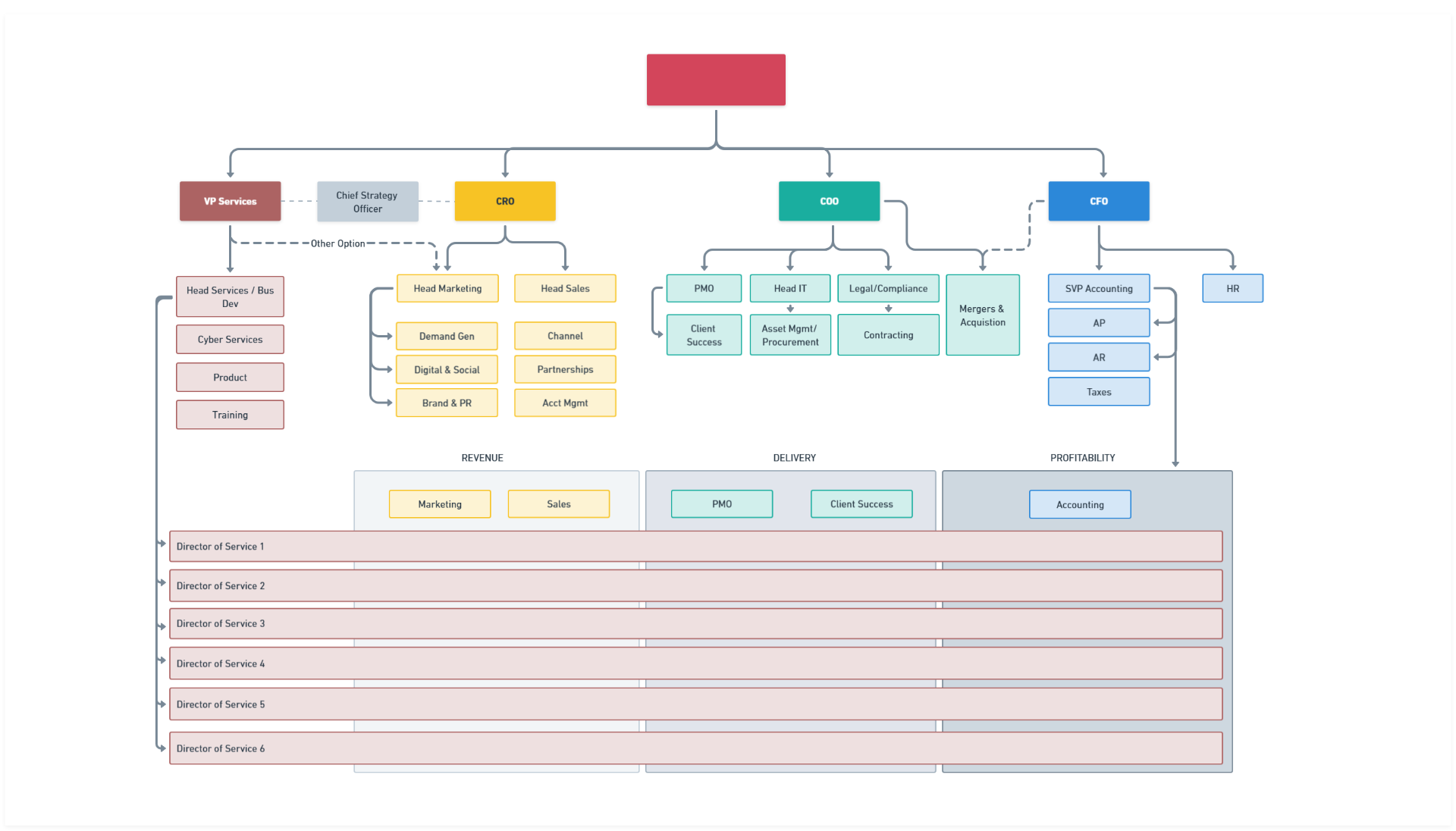
A sample federated org chart showing how different executive functions (Revenue, Delivery, Profitability) own different stages while service directors execute across them.
There is a catch, and it is an important one. Federated models only work if there is a shared source of truth.
If every unit runs its own tools and reports its own version of reality, you do not get federation, you get fragmentation. That is why so much of the writing about federated analytics, federated data governance, and federated AI puts heavy emphasis on a common platform and common standards.
Distributed execution with centralized visibility is the whole point.
The human side is just as real as the structural side.
Federation changes how responsibility feels. In centralized models, people can always point to process, committees, or a central function when things go sideways. In federated models, the responsibility line shortens. Local leaders own their results much more directly. That can be uncomfortable at first. Over time, though, it tends to build stronger leadership benches and clearer performance cultures, because outcomes can no longer hide inside shared abstractions.
Of course there are tradeoffs.
Federation places higher demands on the judgment and maturity of local leaders. It requires real discipline in financial governance. It depends on serious platform adoption and consistent data quality. It forces awkward conversations about who is actually carrying which piece of the load. None of that is free.
But those pressure points are also the mechanisms that make the model work at scale. They drag ownership, information, and decision making into the same place.
So where does that leave the big claim?
It is probably too strong to say that federated operations are the one default model for every scalable organization. The reality is more nuanced. Serious practitioners usually describe centralized, decentralized, and federated as three viable patterns and argue that the right choice depends on context, maturity, and strategy.
What the emerging evidence does support is a narrower and more useful statement:
When organizations try to scale complex, cross functional capabilities like data, analytics, AI, or multi line service delivery, they often end up moving toward some version of a federated or hub and spoke model, precisely because it balances local ownership with enterprise level control.
Centralization still has a place. It belongs in finance, in standards, in platforms, in legal, in strategic governance. Distribution has a place as well. It belongs in execution, in staffing choices, in local client outcomes, in tactical tradeoffs.
When those two forms of authority are deliberately balanced, you get something that pure centralization and loose decentralization both struggle to deliver at scale: control without rigidity, autonomy without chaos.
That is the real reason federated operating models keep showing up in the playbooks of organizations that are trying to grow into their complexity rather than be crushed by it.