From the library
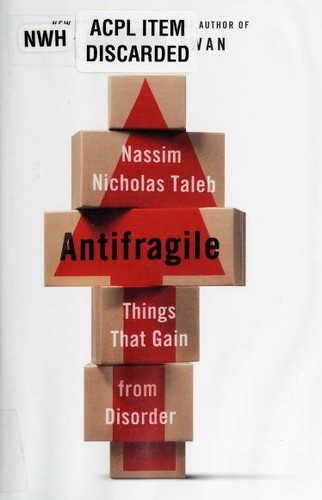
Antifragile
Nassim Nicholas Taleb, 2012
There is no word in English for the opposite of fragile, and the absence of the word is why we keep building the wrong things. It is not resilience. Resilient survives the shock unchanged; antifragile gets better because of it.
In one paragraph
Nassim Nicholas Taleb's exploration of how to gain from disorder and volatility rather than being harmed by it. Introduces the concept of antifragility - systems that become stronger when stressed - and shows how to build antifragile strategies in business, health, politics, and life. Goes beyond resilience to show how uncertainty and volatility can be sources of strength.
Also tagged
Where this sits in the operating system
This is the strongest source in the library for Barbell Strategy and Conservative Margins, and its structural contribution to the framework is a reframing: stop trying to predict better and start changing your exposure so prediction stops mattering. It reaches Inversion Thinking through via negativa, the argument that we know what is harmful far more reliably than what is beneficial, so subtraction is the higher-confidence move.
Compound Leverage
Mental Models & Decision Frameworks
Mental Models & Decision Frameworks
Mental Models & Decision Frameworks
What it does not cover
It gives almost no help with building anything positive. Taleb is superb on avoiding ruin and close to useless on what to do with a robust position once you have one. For direction and construction the framework routes to Purpose and Meaning and to Systems Over Goals, and the tone means the practical core has to be extracted by a reader willing to ignore a great deal of invective.
Read it if
- You carry downside risk you have not consciously priced
- You have noticed that your plans assume the future resembles a smoothed version of the past
- You can tolerate a combative, digressive author to reach a genuinely original idea
Skip it if
- You need operational advice. This is a way of seeing exposure, not a method for running anything
- You have read The Black Swan and want new material. The overlap is substantial and the tone is more abrasive
- The insults will cost you more attention than the argument returns. That is a legitimate reading decision
Before you read on
Name something in your life that would genuinely improve if the next two years were chaotic rather than calm.
Key insights
Sort every exposure into fragile, robust or antifragile by asking what disorder does to it. You can classify without being able to forecast.
The barbell puts most weight in extreme safety and a little in extreme risk, because the moderate middle carries hidden tail exposure while feeling prudent.
Via negativa: we know what harms far more reliably than what helps, so removal is the higher-confidence move.
Recognise it early
The failure and the correction sit side by side deliberately. Read the left column asking whether any of it is already true of you.
Optimizing for efficiency at expense of resilience
Trying to eliminate all volatility and uncertainty
Making detailed predictions instead of building options
Adding complexity to solve problems
Avoiding all failures instead of learning from small ones
How it actually works
Taleb's move is to replace prediction with a question about payoff shape. Rather than asking what will happen, ask what happens to you under a range of outcomes. Three categories: fragile things lose more from disorder than they gain, robust things are indifferent, antifragile things gain. The insight is that you can usually classify your exposure with confidence even when you cannot forecast events at all, and that classification is actionable in a way forecasting never is. Most institutional failure comes from optimising the average case, which quietly maximises fragility to the tails.
The triad
Sort every meaningful exposure into fragile, robust or antifragile by asking what disorder does to it.
Without the sort you evaluate decisions on expected return and remain blind to the shape of the loss.
The barbell
Extreme safety with most of the position, extreme speculative risk with a small remainder, and nothing in the middle.
Without it the moderate-risk middle carries hidden tail exposure while feeling prudent, which is the most dangerous position available.
Optionality
Accumulate cheap options with capped downside and open-ended upside, then let convexity do the work rather than intelligence.
Without options you must be right to gain. With them you can be wrong repeatedly and cheaply while remaining exposed to the one that pays.
Via negativa
Improve by removing. Subtract the fragility, the debt, the dependency, the one input whose failure takes everything down.
Without it you add interventions whose second-order effects you cannot see, which is Taleb's account of most medicine, policy and management.
Skin in the game
Never accept advice or forecasts from someone who bears no cost if they are wrong.
Without it the system reliably transfers fragility from the confident to everyone else, and calls the transfer expertise.
Read the triad before anything else, and be willing to stop there. The classification is the transferable tool; the barbell and optionality are applications of it. Readers who start with the barbell tend to implement it as an asset allocation and miss that Taleb intends it as a general posture toward careers, commitments, health and relationships.
Worked through
You are a contractor with one client providing 80% of your income. The relationship is excellent and has run for three years.
Classify rather than forecast
The question is not whether they will leave. It is what happens to you if they do. One client at 80% is a fragile position no matter how good the relationship, and its quality is what disguises the exposure.
Notice that stability is the risk
Three smooth years have removed every signal that would have prompted diversification. Taleb's point is that the absence of shocks is what allows fragility to accumulate unnoticed.
Build the safe end
Enough runway to survive the loss without needing the next client urgently. Urgency is what converts a setback into accepting bad terms.
Buy cheap options at the other end
Several small speculative bets: a product, writing, two exploratory conversations a month. Capped cost, uncapped upside, and no requirement that any specific one works.
Remove before you add
Via negativa first. Cut the fixed costs that make the 80% feel non-negotiable. Reducing the downside is higher-confidence than finding a second client.
The same idea, argued differently
These books share the conviction that the future is not forecastable. They differ on whether the response is humility, indexing, better calibration, or asymmetric exposure.
Ron Chernow
Burton Malkiel
Shares the scepticism about forecasting and rejects the remedy. Malkiel concludes broad diversification and indexing, precisely the moderate middle Taleb calls the most fragile position available.
David R. York, Andrew L. Howell
Saifedean Ammous
Where it overreaches
Taking the book seriously means knowing where it is weakest.
The tone actively costs the book readers.
Extended personal attacks on named academics and journalists occupy real space. Some is entertaining, much is self-indulgent, and it makes an important argument easy to dismiss as a personality.
Antifragility is defined loosely enough to be unfalsifiable in places.
Because gains from disorder are assessed after the fact, almost any survivor can be relabelled antifragile in retrospect. The triad is a powerful lens and a weak theory.
The barbell requires capital and optionality requires slack.
Someone with no savings cannot put 90% in safety, and someone working two jobs has no capacity for speculative bets. The advice is far more available to the already-secure than the book acknowledges.
Via negativa is asserted as a general law on thin grounds.
That we know harm better than benefit is well supported in medicine and much weaker elsewhere. Taleb generalises from the domains where it holds to all domains, which is the error he spends the book attacking in others.
What the book still has that this page does not
Everything above is the transferable part. Here is what does not survive compression, so you can decide whether the full read is worth it to you.
The historical and biological range
Hormesis, Roman engineering, restaurant ecosystems, mythology. The triad only becomes a general lens after you have watched it applied across unrelated domains, and that requires volume.
The Procrustean bed material
The sustained argument that we damage reality to fit our models is the philosophical core, and it is the part summaries drop in favour of the barbell.
The abrasiveness itself
Uncomfortable to defend, but the contempt is doing rhetorical work. Taleb is arguing that politeness toward fragility-transferring experts is part of the mechanism, and a neutral rendering removes the argument along with the tone.
The full breakdown
Before you close this
Naming the specific moment you will act roughly doubles the odds you do.
Use this when a plan's success depends on a forecast, and someone has just called the forecast conservative.
Reference
- Author
- Nassim Nicholas Taleb
- Published
- 2012
- Category
- Business
We value your privacy
We use cookies to enhance your experience, analyze site traffic, and personalize content. You can manage your preferences or learn more in our Privacy Policy.