From the library
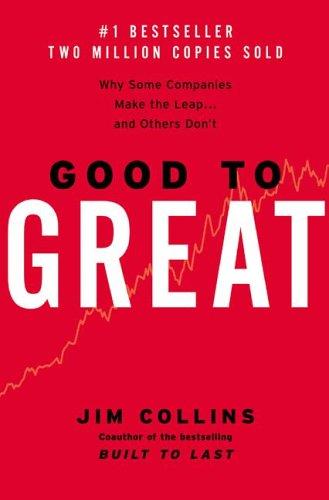
Good to Great
Jim Collins, 2001
Greatness is not a strategy, a leader or a market. It is a set of unglamorous disciplines held for long enough that the compounding becomes visible from outside as a breakthrough.
In one paragraph
Jim Collins' research-based study of what makes companies transition from good to great. Identifies key principles including Level 5 Leadership, getting the right people on the bus, confronting brutal facts, and building a culture of discipline. Based on extensive research comparing good companies to great ones. Best read during scale-up phase.
Also tagged
Where this sits in the operating system
This is the anchor for People and Relationships in the library and the source of three of its four sub-principles. Right People First comes from the bus metaphor, Humble Excellence from Level 5 leadership, and Brutal Facts with Faith from the Stockdale paradox. Its structural contribution to the framework is the claim that personnel decisions precede strategic ones, which is the reverse of how most planning is sequenced.
People & Relationships
People & Relationships
People & Relationships
People & Relationships
What it does not cover
It has very little to say about what the company should actually do. The Hedgehog Concept is presented as discoverable rather than chosen, and there is no treatment of competitive position, market structure or timing. For that the framework routes to Mental Models and Decision Frameworks, and specifically to the strategy books, where Rumelt and Porter supply what Collins deliberately brackets.
Read it if
- You lead an organisation that is competent, stable and not improving
- You suspect your problem is who rather than what, and want the argument made properly
- You want the vocabulary. Level 5, the bus, the flywheel and brutal facts are now common currency and this is where they come from
- You are about to hand a strategy to a team you did not choose
Skip it if
- You need strategy. The book is explicit that it studied how, not what, and readers keep expecting otherwise
- You are pre-product or early stage. The sample is large established companies and the findings do not transfer down
- You are troubled by methodology. If selecting on the dependent variable bothers you, this book will bother you for three hundred pages
Before you read on
In your organisation, who decides what gets done: the plan, or the people already in the room?
Key insights
Good is the enemy of great, because adequate performance removes the pressure that would force a change.
First who, then what. Strategy handed to the wrong team is executed into the ground; the right team rewrites a mediocre strategy on contact.
The Stockdale paradox requires both halves at once: confront the brutal facts and retain absolute faith. Either alone breaks the organisation in one direction.
Recognise it early
The failure and the correction sit side by side deliberately. Read the left column asking whether any of it is already true of you.
Accepting good performance instead of pursuing greatness
Focusing on strategy before getting right people
Avoiding difficult realities or being overly pessimistic
Pursuing too many priorities or losing focus
Leading for personal recognition rather than organizational success
How it actually works
Collins took eleven companies that produced fifteen years of ordinary returns followed by fifteen years of extraordinary ones, matched them against comparison companies that did not make the leap, and looked for what differed. The findings were mostly the opposite of what his team expected, which is the strongest thing about the book: no charismatic saviours, no acquisitions, no technology-led transformations, no change programmes. What separated the two groups was a sequence of disciplines applied consistently and unremarkably over a long period, and a leadership profile so unfashionable that the team initially tried to argue it away.
Level 5 leadership
Personal humility joined to ferocious professional will. Ambition directed at the institution rather than the self, and successors set up to do better.
Without it results are tied to a personality and decay when the personality leaves, which is what the comparison companies repeatedly demonstrated.
First who, then what
Get the right people on the bus and the wrong people off it before deciding where the bus goes.
Without it every strategic change requires a rebuilding of the team, so the organisation is permanently one step behind its own plans.
Confront the brutal facts
Build a culture where the truth is heard, while retaining absolute faith that you will prevail. The Stockdale paradox: both, at once, without softening either.
Without it optimism curdles into denial, and the people closest to the problem stop reporting it upward.
The Hedgehog Concept
The intersection of what you can be best in the world at, what drives your economic engine, and what you are deeply passionate about.
Without the intersection you get activity in all three circles separately, which is indistinguishable from a diversified mediocrity.
The flywheel
Consistent pushes in one direction accumulating momentum, with no single defining moment.
Without it the organisation reorganises every eighteen months, and never holds a direction long enough for compounding to occur.
The sequence is the argument and it is routinely dismantled in practice. Organisations adopt the Hedgehog Concept as a workshop exercise, skip the personnel work, and produce a laminated statement of purpose that the existing team ignores. Collins's claim is that the Hedgehog is discoverable only by the right people confronting brutal facts over years, which means it cannot be an offsite deliverable.
Worked through
You inherit a division that hits its numbers, has low turnover, and has not produced anything new in four years.
Resist starting with strategy
The instinct is a new plan in the first ninety days. Collins's finding is that this is the third step. A plan handed to a team that produced four flat years will be executed into the same four years.
Assess the bus honestly
Not performance ratings, which are calibrated to the current low bar. The question is which of these people you would enthusiastically rehire into this seat knowing what you now know.
Make the brutal fact sayable
Low turnover and flat output usually means dissent stopped being worth the cost. Ask questions rather than issue statements, and notice whether anyone tells you something you did not want to hear.
Look for the intersection rather than inventing it
What has this division genuinely been better at than anyone else, even while stagnating? The Hedgehog is found in the record, not generated in a room.
Then push the same direction for longer than feels reasonable
The flywheel finding is that no push feels decisive. If you reorganise at month nine you will never learn whether the direction was right.
The same idea, argued differently
This cluster is about making performance independent of any individual. They split on whether you achieve that through exceptional people or through a system that does not need them.
Ron Chernow
Marty Cagan
Where it overreaches
Taking the book seriously means knowing where it is weakest.
It selects on the dependent variable.
Picking winners and looking backwards for shared traits cannot distinguish causes from coincidences, and will find patterns in noise given enough variables. This is the standard objection and it is correct.
The sample has not held up.
Circuit City went bankrupt. Fannie Mae required a federal rescue. Wells Fargo produced a mass fraud scandal. A book whose entire authority rests on the durability of its eleven cannot be assessed independently of what happened to them.
The findings are largely unfalsifiable as stated.
No organisation ever concludes it has the wrong people and refuses to confront brutal facts. The disciplines are stated in terms that every leader believes they already satisfy, which is why they generate agreement rather than change.
It brackets strategy and market conditions almost entirely.
Collins is upfront that he studied how rather than what, but the effect is a book about excellence that never asks whether the company was in a good business at a good time, which for several of the eleven appears to have mattered a great deal.
What the book still has that this page does not
Everything above is the transferable part. Here is what does not survive compression, so you can decide whether the full read is worth it to you.
The comparison companies
The method is the argument. Reading what Scott Paper did while Kimberly-Clark did the other thing is what makes the findings land, and no summary carries the contrast pairs.
The research narrative
Collins repeatedly documents his team being wrong and arguing with the data. That is what separates the book from the imitators it spawned, and it is invisible in any list of the five disciplines.
The Stockdale interview in full
Compressed it is a paradox with a name. At length it is a specific account of who died first and why, and it is considerably more disturbing and more useful.
The full breakdown
Before you close this
Naming the specific moment you will act roughly doubles the odds you do.
Use this when you are about to solve a performance problem by writing a better plan for the same team.
Reference
- Author
- Jim Collins
- Published
- 2001
- Category
- Business
We value your privacy
We use cookies to enhance your experience, analyze site traffic, and personalize content. You can manage your preferences or learn more in our Privacy Policy.