From the library
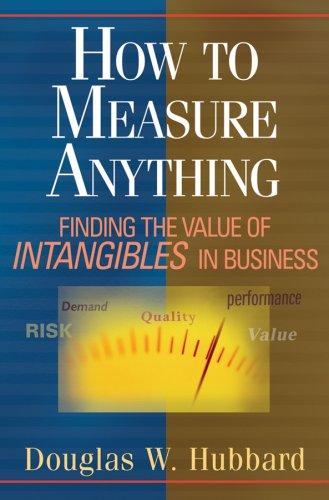
How to Measure Anything
Douglas W. Hubbard, 2007
In one paragraph
Hubbard's claim is that anything that matters is observable, anything observable can be quantified, and the demand for precision is what stops people measuring at all. The contribution is the reframe from measurement as certainty to measurement as uncertainty reduction, plus calibration training that is genuinely testable. Most useful when a decision is stalled on the grounds that something is intangible. Least useful if you want quick answers; the statistics are real work.
Where this sits in the operating system
Systems Over Goals
Continuous Improvement & Feedback Loops
Systems Over Goals
Mental Models & Decision Frameworks
Key insights
If it matters, it is observable; if observable, it can be quantified. The word intangible usually means unmeasured, not unmeasurable.
Measurement reduces uncertainty. It does not have to eliminate it, and demanding precision is what stops people measuring at all.
Calibration is trainable, and most people are badly overconfident until tested. That test is the most useful hour in the book.
Recognise it early
The failure and the correction sit side by side deliberately. Read the left column asking whether any of it is already true of you.
Measuring for curiosity
Analysis paralysis
Overprecision
Ignoring proxies
No experiments
The same idea, argued differently
Brian Christian, Tom Griffiths
Peter Drucker
Gene Kim, Kevin Behr, George Spafford
Ryan Deiss
The full breakdown
Before you close this
Naming the specific moment you will act roughly doubles the odds you do.
Reference
- Author
- Douglas W. Hubbard
- Published
- 2007
- Category
- Business
We value your privacy
We use cookies to enhance your experience, analyze site traffic, and personalize content. You can manage your preferences or learn more in our Privacy Policy.