From the library
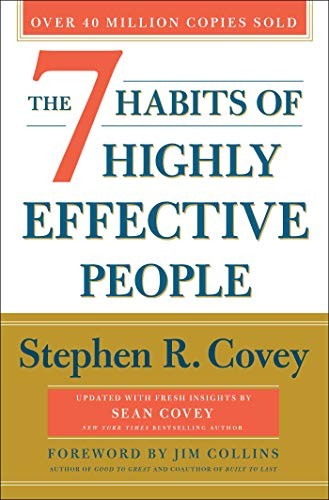
The 7 Habits of Highly Effective People
Stephen Covey, 1989
Effectiveness is not a set of techniques laid over whoever you already are. It is character, expressed as habit, in a fixed order: master yourself first, then work with others, then renew the instrument doing the work.
In one paragraph
A holistic approach to personal and interpersonal effectiveness, presenting seven principles for developing character and achieving success through principle-centered living.
Also tagged
Where this sits in the operating system
This is the framework's closest antecedent and should be read as such. Covey's structure, a small number of principles compounding in a fixed order from private to public to renewal, is the same architecture Axis Seven uses, which makes it the most important comparison in the library. It carries Priority Hierarchy through the urgent-important matrix and Internal Scorecard through the argument that effectiveness begins with a self-authored centre.
Focus & Essentialism
Purpose & Meaning
Purpose & Meaning
People & Relationships
What it does not cover
It predates almost everything now known about how habits actually form. Covey asserts that character produces habit and offers little mechanism for installing one. For that the framework routes to Systems Over Goals, where Clear and Fogg supply the machinery Covey assumes. It is also silent on organisational and market conditions, treating almost every problem as a problem of individual character.
Read it if
- You are effective at execution and unsure the execution is aimed at anything
- You want the origin of ideas you have absorbed second-hand for years
- You are interested in how a durable framework is structured, not only in what it says
Skip it if
- You want mechanism. The habit-formation content is dated and largely superseded
- The register will lose you. It is earnest, occasionally sermonising, and unembarrassed about it
- You need something short. The ideas are simple and the book is not
Before you read on
When you last had a conflict with someone, how much of your effort went into being understood, and how much into understanding?
Key insights
Private victory before public victory. Attempting habits four to six without one to three produces manipulation with good vocabulary.
P/PC balance: harvesting output while neglecting the asset producing it is the shape of nearly all durable failure.
Seek first to understand. The ratio of effort spent being understood to understanding is the fastest self-diagnostic in the book.
Recognise it early
The failure and the correction sit side by side deliberately. Read the left column asking whether any of it is already true of you.
Focusing on Circle of Concern instead of Circle of Influence
Trying to change others before changing yourself
Seeking quick-fix techniques over character development
Listening with intent to reply rather than understand
Compromise instead of seeking synergistic win-win solutions
How it actually works
Covey's organising claim is that the self-help literature of the previous fifty years had shifted from a character ethic to a personality ethic, from who you are to techniques for appearing a certain way, and that techniques applied over unresolved character produce a person who is efficient and untrustworthy. His sequence is therefore deliberately slow. Three habits establish independence, three establish interdependence, and the seventh maintains capacity. The order is the argument: attempting the public habits before the private ones produces manipulation, because seeking mutual benefit without having settled your own principles is just negotiation.
Private victory: 1 to 3
Be proactive, begin with the end in mind, put first things first. Responsibility for response, a defined destination, and a priority discipline grounded in the urgent-important matrix.
Without these you are reactive, busy, and organising a calendar against goals you have not chosen.
Public victory: 4 to 6
Think win-win, seek first to understand then to be understood, synergise. Abundance rather than scarcity, empathic listening before advocacy, and creative third alternatives.
Without the private victory first, these become techniques for getting your way while appearing collaborative, which is the personality ethic Covey is attacking.
Sharpen the saw
Renewal across physical, mental, social and spiritual dimensions, treated as the habit that makes the other six sustainable.
Without it capacity erodes under the load the first six create, and the whole structure degrades within a year.
The P/PC balance, production against production capability, is the concept that holds the whole thing together and is the one most often dropped from summaries. Covey's argument is that almost all durable failure comes from harvesting output while neglecting the asset producing it, whether that asset is a machine, a relationship or a body. Read with it, the seventh habit is structural; read without it, it looks like advice about exercise.
Worked through
You are two years into a role you are good at, working long hours, with a growing sense that none of it is going anywhere you chose.
Separate what is yours
Habit 1 is not positivity. It is auditing which parts of this situation are actually within your circle of influence, and noticing how much energy is going to the parts that are not.
Write the destination before optimising the route
Habit 2. Not a career plan. A description of what you want to be true in ten years and what you want said about how you worked. Efficiency without this is what produced the current position.
Audit the week against the matrix
Most of the long hours will be quadrants one and three: urgent, and much of it not important. Quadrant two, the strategic and developmental work, is what got displaced.
Schedule the important before the urgent arrives
Covey's mechanism is to place quadrant two work in the calendar first and let the urgent fill what remains. Reversing that order is why everyone agrees with the matrix and nobody uses it.
Protect the capacity, not just the output
P/PC. Two years of long hours has been drawing down the asset. Renewal is not a reward for finishing; it is the condition of continuing.
The same idea, argued differently
These books all order personal change from the inside outward. They disagree about whether the interior work causes the behaviour or the behaviour causes the interior.
Frank Slootman
Plato
Ron Chernow
Angela Duckworth
Where it overreaches
Taking the book seriously means knowing where it is weakest.
The evidence is Covey's assertion and his consulting experience.
There is no research base. The framework is derived from a survey of two centuries of success literature interpreted by one author, and its authority rests on how sensible it sounds.
The habit-formation model is superseded.
Covey treats habit as the intersection of knowledge, skill and desire, which is closer to a definition than a mechanism. Everything now known about cues, friction and environment is absent.
It attributes to character what is often structural.
Be proactive is sound counsel and a poor account of constrained circumstances. The book has almost nothing to say about power, market conditions or organisations where the reactive posture is rationally imposed.
The seventh habit is under-specified relative to its load.
Renewal is asked to sustain the other six and receives the thinnest treatment, particularly the spiritual dimension, which is largely left to the reader's own tradition.
What the book still has that this page does not
Everything above is the transferable part. Here is what does not survive compression, so you can decide whether the full read is worth it to you.
The P/PC distinction developed at length
The single most transferable idea in the book and the one that disappears from every summary, including the paragraph above. It needs the examples to become a lens rather than a phrase.
The empathic listening material
Habit 5 is the most practically valuable chapter and depends on extended transcripts. Reduced to seek first to understand it becomes a slogan people already agree with and do not do.
The moral seriousness
Covey means this as an argument about how to be a person, not how to be productive. That framing is what makes the sequence coherent, and stripping it leaves seven disconnected tips.
The full breakdown
Before you close this
Naming the specific moment you will act roughly doubles the odds you do.
Use this when you are efficient, busy and quietly unsure whether any of it is pointed anywhere.
Reference
- Author
- Stephen Covey
- Published
- 1989
- Category
- Self-Help
We value your privacy
We use cookies to enhance your experience, analyze site traffic, and personalize content. You can manage your preferences or learn more in our Privacy Policy.