From the library
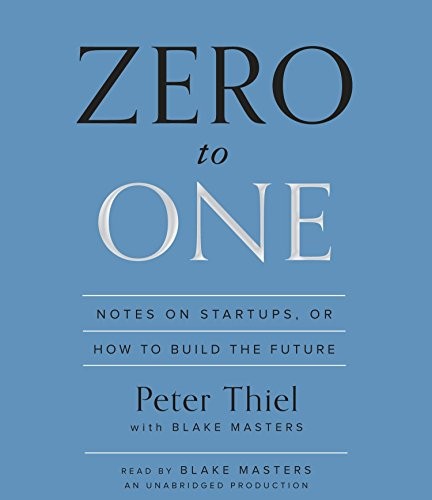
Zero to One
Peter Thiel, Blake Masters, 2014
Every moment in business happens once. The next Bill Gates will not build an operating system, and the second person to do anything is not doing the thing that mattered. Copying takes the world from 1 to n. The hard, valuable move is 0 to 1.
In one paragraph
Thiel argues for creating new categories (zero to one) instead of competing, building monopoly‑like advantages through secrets, focus, and definite optimism guided by a clear plan.
Also tagged
Where this sits in the operating system
This is the contrarian pole of Mental Models and Decision Frameworks and the clearest argument in the library for Single-Point Focus at the level of strategy rather than the calendar. Its contribution is the case for definite optimism: that a specific plan beats iteration, that monopoly rather than competition is the goal, and that power laws mean concentration is rational where diversification feels safer.
Focus & Essentialism
Mental Models & Decision Frameworks
Mental Models & Decision Frameworks
What it does not cover
It says almost nothing about execution, operations or people, and it is written from a position of extraordinary selection bias. For building the thing once the thesis exists, the framework routes to Systems Over Goals, and The Lean Startup is held in the same library as the direct counter-argument.
Read it if
- You are deciding what to build rather than how to build it
- You are in a market where everyone is doing approximately the same thing slightly better
- You want a genuinely uncomfortable argument rather than reassurance
Skip it if
- You are running an operating business. This is about founding, and the advice does not transfer
- You need evidence. It is a lecture-derived argument from one investor's experience, not a study
- Politics will get in the way. Thiel's worldview is present throughout and is not separable from the argument
Before you read on
What important truth do very few people agree with you on?
Key insights
What important truth do very few people agree with you on? Without an answer you have a plan to compete, not a business.
Competition drives profit to zero, so a competitive market means you are capturing little of the value you create.
Distribution decides more outcomes than product quality. The chapter everyone skips is the one most likely to change what you do.
Recognise it early
The failure and the correction sit side by side deliberately. Read the left column asking whether any of it is already true of you.
Copying successful models instead of creating new solutions
Competing in crowded markets instead of creating monopoly advantages
Following conventional wisdom instead of independent thinking
Pursuing broad markets instead of focused domination
Distributing resources equally instead of power law focus
How it actually works
Thiel's central inversion is that competition is not the goal but the failure state. Perfect competition drives profit to zero, so a business in a competitive market is by definition capturing little of the value it creates. Monopoly, in his usage, means being the only one who does what you do well enough that comparison is beside the point, and he argues companies lie about this in both directions: monopolists describe themselves as one of many, and competitive businesses describe themselves as unique by narrowing the market definition until they are. Underneath sits the power law: outcomes are so unevenly distributed that a diversified portfolio of reasonable bets underperforms a concentrated bet on the thing that could be enormous.
The contrarian question
Identify the truth you hold that consensus rejects. This is the seed of any 0 to 1 business.
Without it you are executing a known plan, which means competing on execution against everyone else who can read.
Start with a monopoly on something tiny
Dominate a small, specific market completely, then expand outward into adjacent ones.
Without it you take 1% of a huge market, which sounds impressive in a deck and means you are undifferentiated in all of it.
The four characteristics
Proprietary technology an order of magnitude better, network effects, economies of scale, and brand.
Without at least one, any advantage you build is competed away as soon as it is visible.
Definite optimism
A specific plan for a specific future, held and executed, rather than keeping options open and iterating toward whatever appears.
Without it you get indefinite optimism: the belief that the future will be better with no account of how, which Thiel argues is the dominant modern posture and produces process rather than progress.
Power law awareness
In investing and in career choice, a small number of outcomes dominate everything else combined.
Without it you diversify into a portfolio whose expected value is dominated by the bet you declined to concentrate on.
The chapter on distribution is the one readers skip and the one most likely to change what they do on Monday. Thiel's claim is that engineers systematically believe a superior product sells itself, that this is nearly always false, and that a company with a mediocre product and excellent distribution beats the reverse. Read after the monopoly argument it lands as the mechanism; read alone it reads as generic sales advice.
Worked through
You are considering a developer tool in observability, a market with several well-funded incumbents and a widely agreed direction of travel.
State the contrarian truth or stop
Everyone agrees observability matters. That is not a thesis. The thesis has to be something the incumbents believe is wrong, such as that the entire query-based model is the reason nobody actually uses these tools during an incident.
Check whether it is 0 to 1 or n to n plus one
Cheaper, faster and nicer than an incumbent is 1 to n. Real, order-of-magnitude difference in a specific dimension is the only defensible starting position.
Find the smallest market you could own outright
Not developers. Not observability. Incident response for teams of eight to thirty running a particular stack, where you could plausibly be used by most of them.
Decide the durable advantage before building
Which of the four will hold in three years? If the honest answer is none, the product will be copied within a year of demonstrating the demand.
Design distribution first, not last
Work out how the tenth and the thousandth customer arrive before you write the code. Thiel's point is that this determines the outcome more often than the product does.
The same idea, argued differently
This cluster is about where advantage comes from. They divide on whether you discover it by iterating or decide it in advance and then hold it.
Sun Tzu
Nassim Nicholas Taleb
Jeff Booth
Clayton Christensen
Explains why incumbents leave the opening. Christensen shows the gap is created by rational incumbent behaviour rather than by incumbent stupidity.
Where it overreaches
Taking the book seriously means knowing where it is weakest.
It is one investor generalising from an extraordinary run.
PayPal, Facebook, Palantir. There is no accounting for the contrarian theses that were simply wrong, and survivorship bias is the entire shape of the evidence.
Monopoly is used in a way that elides the costs.
The book treats monopoly purely as a founder's objective and barely engages with what monopolies do to customers, suppliers, workers or markets. That is a substantial omission in a book that names the concept as the goal.
The contrarian question is close to untestable in advance.
You cannot tell a valuable contrarian truth from an ordinary error until the outcome arrives. The framing rewards conviction, and conviction is precisely what unsuccessful founders also have in abundance.
It is a book about founding presented as a book about thinking.
The specific advice applies to a narrow moment in a narrow kind of company. Read as general strategy by people running established businesses it produces bad decisions with unusual confidence.
It is a 2014 book about the future.
The examples stop before the platform consolidation, the crypto cycle and the current wave of AI capital. Several of the industries Thiel describes as sleepy have since been reshaped, and the specific claims about what is 0 to 1 have aged less well than the underlying question.
What the book still has that this page does not
Everything above is the transferable part. Here is what does not survive compression, so you can decide whether the full read is worth it to you.
The full distribution chapter
It is the most immediately actionable material in the book, the least quoted, and the part technical founders most need to sit with rather than skim.
The last-mover argument and the cash-flow reasoning
Thiel works through why most of a company's value sits far in the future and what that implies about durability. Compressed to be a last mover it is a slogan; worked through it is a valuation argument.
The seven questions
Engineering, timing, monopoly, people, distribution, durability, secret. As a checklist against a real plan they are unusually sharp, and they only work applied in full.
The full breakdown
Before you close this
Naming the specific moment you will act roughly doubles the odds you do.
Use this when a plan's strongest argument is the size of the market and the weakest is why anyone would choose you.
Reference
- Author
- Peter Thiel, Blake Masters
- Published
- 2014
- Category
- Business
We value your privacy
We use cookies to enhance your experience, analyze site traffic, and personalize content. You can manage your preferences or learn more in our Privacy Policy.